
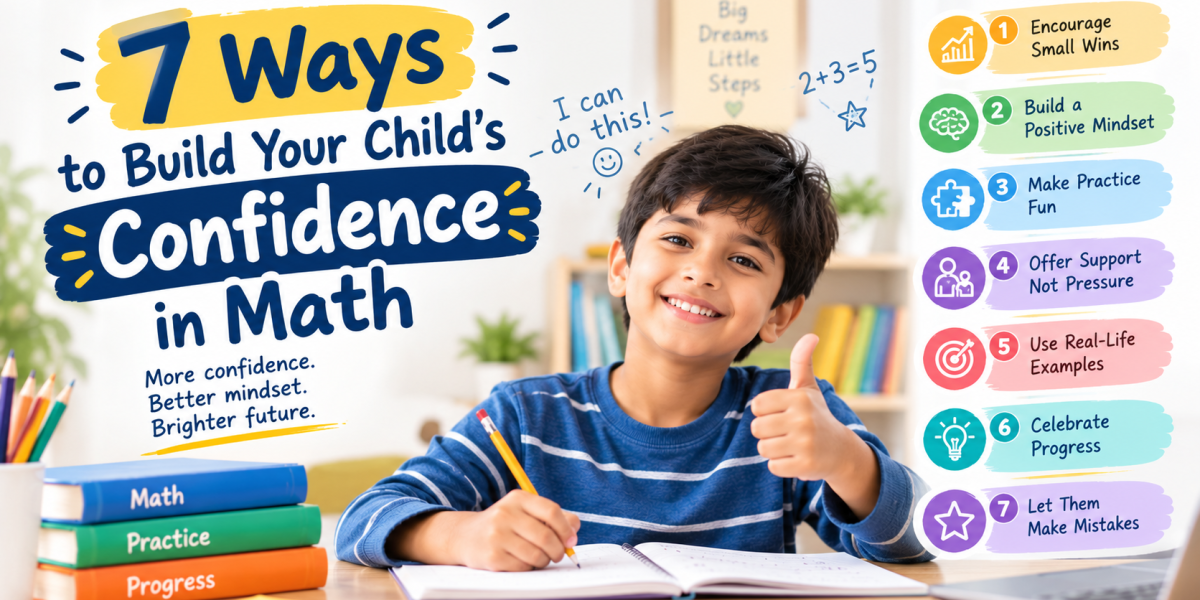
Confidence plays a major role in how children approach math. Students who believe they can improve are more willing to try, practice, and persist.
If your child lacks confidence in math, there are simple ways to help.
Focus on Progress, Not Perfection
Celebrate improvement.
Instead of only praising correct answers, recognize effort:
- “You worked hard on that.”
- “You improved from last week.”
Small wins build confidence.
Treat Mistakes as Learning Opportunities
Mistakes help children learn.
Encourage your child to review errors and understand what went wrong rather than fear being wrong.
Break Big Problems into Small Steps
Large problems can feel intimidating.
Teach children to solve one step at a time.
Breaking work into smaller tasks makes math feel manageable.
Practice Daily
Consistency builds familiarity.
Even 15–20 minutes of regular practice can improve:
- Accuracy
- Speed
- Confidence
Use Fun Learning Activities
Make math engaging through:
- Puzzles
- Games
- Visual tools
- Real-life examples
Fun experiences can reduce anxiety.
Set Achievable Goals
Help your child set simple goals like:
- Master multiplication facts
- Improve quiz score by 10%
- Solve 5 word problems independently
Achieving goals builds motivation.
Learn with the Right Guidance
Support from an experienced teacher can make a major difference.
Personalized guidance helps children:
- Understand concepts clearly
- Ask questions freely
- Gain confidence through success
Confidence in math can be built.
With encouragement, regular practice, and the right learning support, children can move from “I can’t do this” to “I can do this.”