
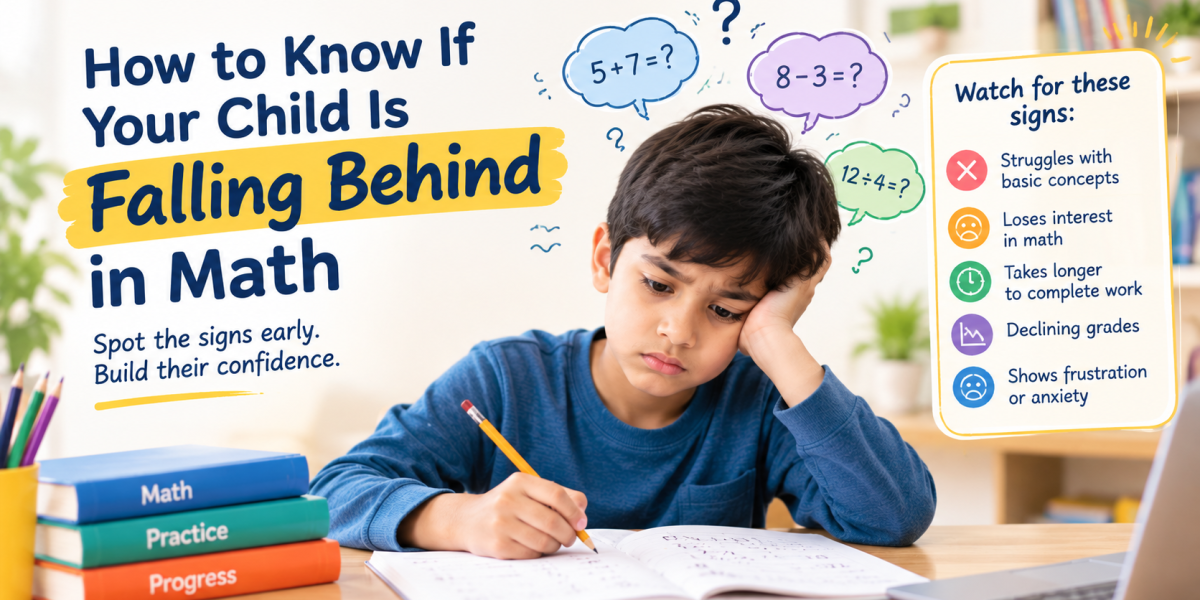
Math builds step by step. When a child misses a foundational concept, future topics can become harder to understand. Sometimes learning gaps develop quietly, and parents may not notice until test scores drop or frustration increases.
The good news is that early signs can be identified, and with the right support, children can regain confidence and improve.
In this blog, we’ll explore common signs that your child may be falling behind in math and what you can do to help.
Your Child Avoids Math Homework
If your child regularly delays, avoids, or gets upset when it’s time for math homework, this may be a sign they are struggling.
Possible reasons include:
- Concepts feel confusing
- They fear making mistakes
- Work takes longer than expected
- They feel overwhelmed
Avoidance often signals frustration rather than laziness.
Basic Calculations Take Too Long
Children should gradually become more comfortable with age-appropriate calculations.
If your child struggles with:
- Addition and subtraction facts
- Multiplication tables
- Fractions
- Mental math
They may need extra practice or support to strengthen core skills.
Word Problems Cause Confusion
Many students can perform calculations but struggle when math is presented in story form.
Signs include:
- Difficulty identifying what the question is asking
- Trouble translating words into equations
- Guessing instead of solving systematically
Word problems often reveal gaps in problem-solving skills.
Low Confidence Around Math
Statements like:
- “I’m bad at math.”
- “I can’t do this.”
- “Math is too hard.”
can signal declining confidence.
Confidence and performance are closely connected. When students doubt themselves, they often participate less and practice less.
Test Scores Are Dropping
Lower scores may point to:
- Knowledge gaps
- Weak understanding of concepts
- Test anxiety
- Lack of guided practice
A pattern matters more than a single score.
How Parents Can Help
Create a safe space for your child to ask questions without fear.
Sometimes revisiting basics can solve bigger problems.
Short daily practice sessions can improve skills over time.
Targeted instruction can identify specific learning gaps.
Why a Math Assessment Helps
A structured math assessment can reveal:
Early action can prevent small gaps from becoming major struggles.
Falling behind in math does not mean a child cannot succeed. It often means they need the right support at the right time.
Recognizing the signs early can help your child rebuild confidence and strengthen skills.