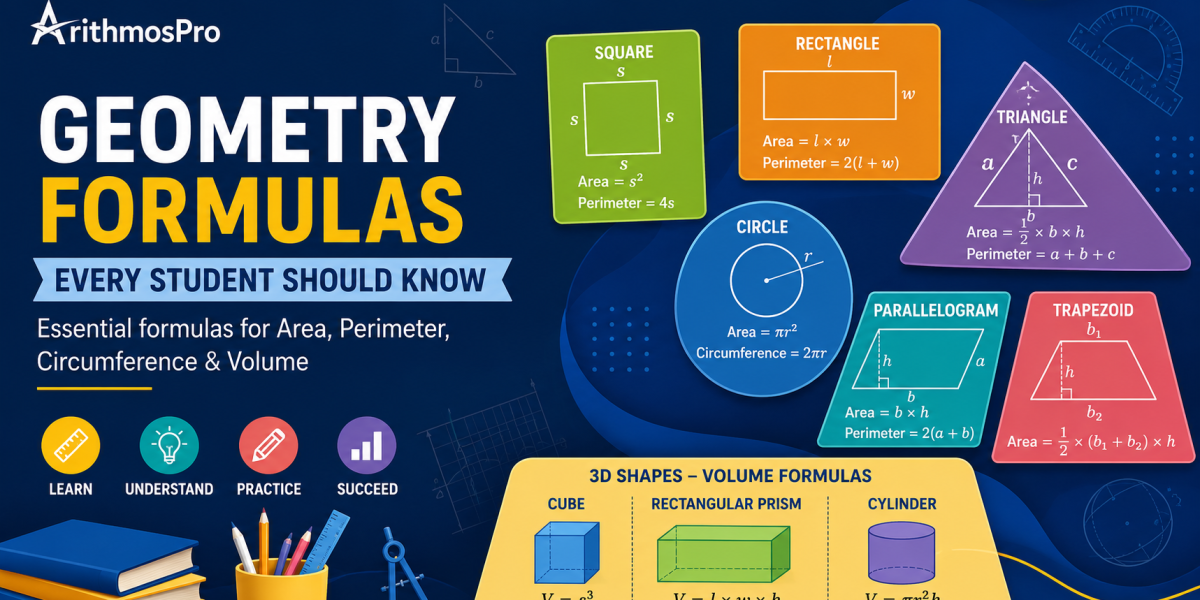
Geometry is an essential part of mathematics that helps students understand shapes, sizes, angles, and measurements. From calculating the area of a bedroom floor to finding the volume of a box, geometry formulas are useful in both schoolwork and everyday life.
However, remembering multiple formulas can sometimes be challenging for students. The best way to learn geometry is to understand what each formula means, see how it works, and practice solving problems.
In this guide, we’ll cover the most important geometry formulas every student should know, including area, perimeter, circumference, and volume, with simple examples to make learning easier.
What Are Geometry Formulas?
Geometry formulas are mathematical rules used to calculate measurements of different shapes. They help students solve problems involving two-dimensional (2D) and three-dimensional (3D) figures.
Before learning individual formulas, it is important to understand four basic concepts:
Area
The amount of space inside a 2D shape, measured in square units.
Perimeter
The total distance around the boundary of a 2D shape.
Circumference
The distance around a circle.
Volume
The amount of space occupied by a 3D object, measured in cubic units.
Let’s explore the essential formulas for different geometric shapes.
Square Formulas
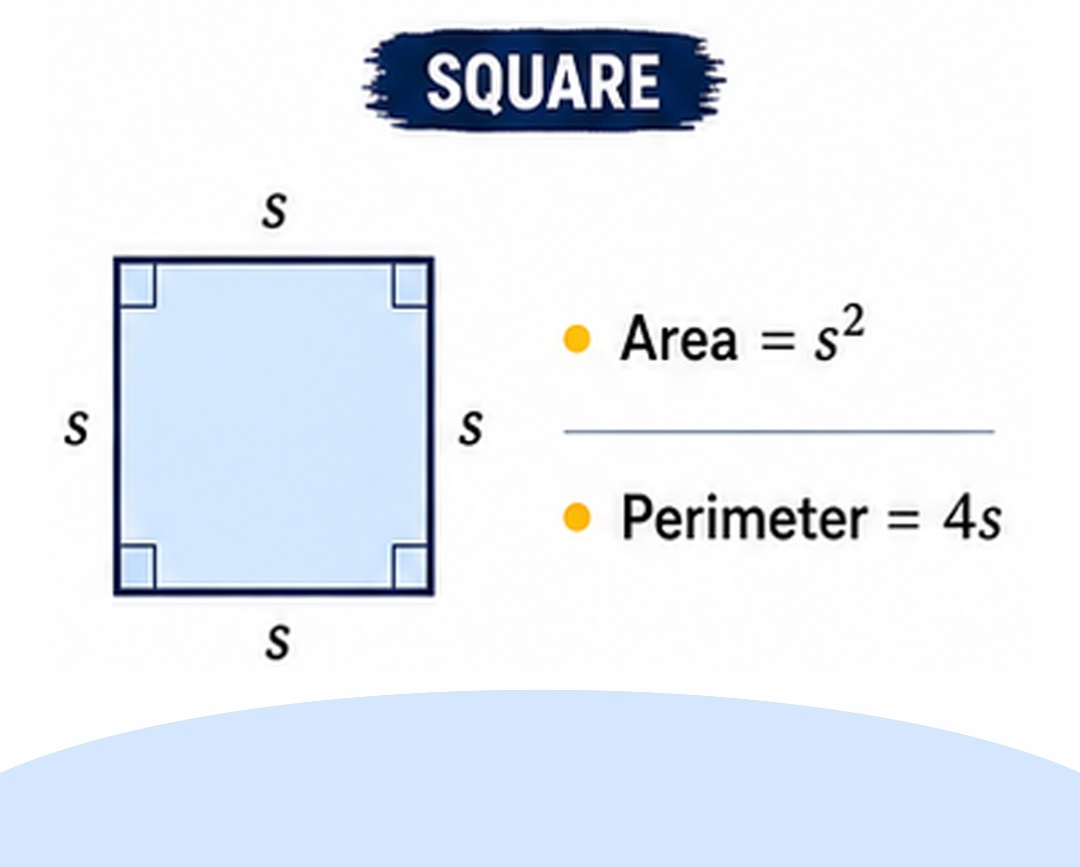
A square is a four-sided shape with four equal sides and four right angles.
Important formulas:
- Area = side × side = s²
- Perimeter = 4 × side = 4s
Example:
Suppose a square has a side length of 6 inches.
Area = 6 × 6 = 36 square inches
Perimeter = 4 × 6 = 24 inches
Real-life application: These formulas can help calculate the area of a square floor tile or the distance around a square garden.
Rectangle Formulas
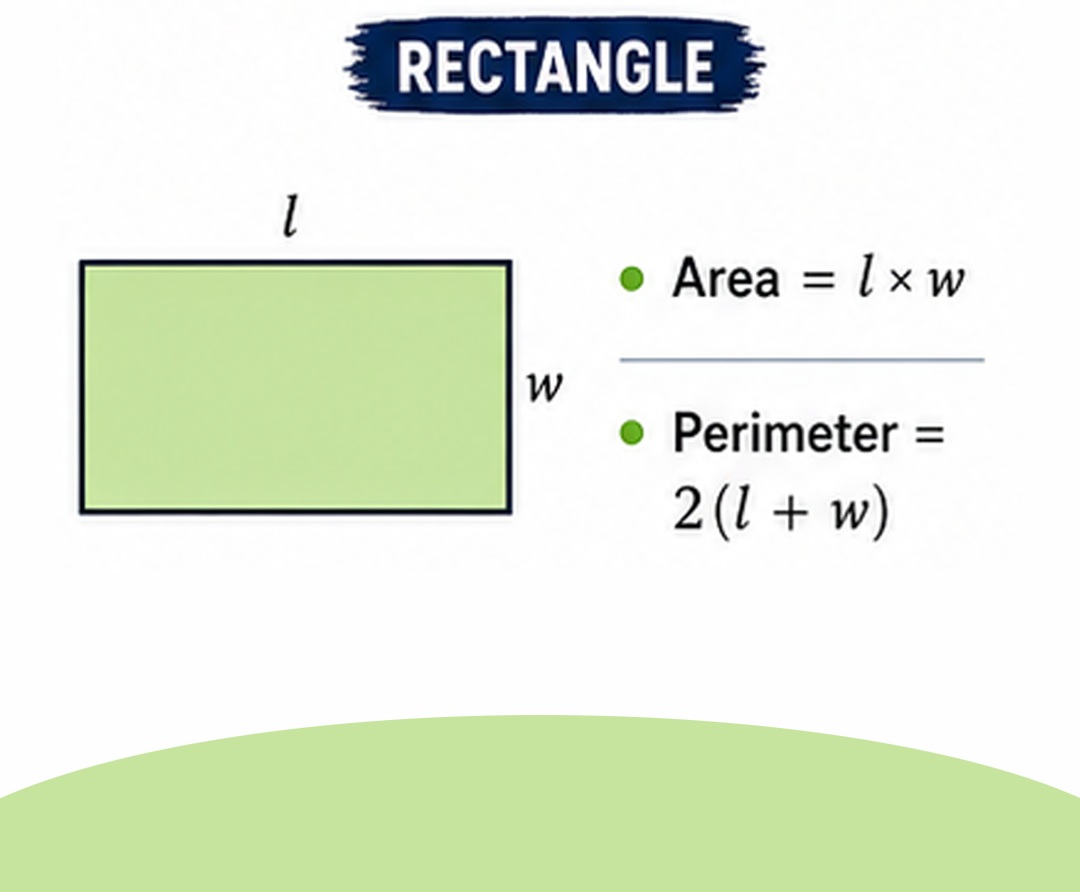
A rectangle has four sides, with opposite sides equal and four right angles.
Important formulas:
- Area = length × width
- Perimeter = 2 × (length + width)
Example:
A rectangle is 10 feet long and 4 feet wide.
Area = 10 × 4 = 40 square feet
Perimeter = 2 × (10 + 4) = 28 feet
Real-life application: Students can use rectangle formulas to calculate the floor space of a room or determine how much fencing is needed around a rectangular yard.
Triangle Formulas
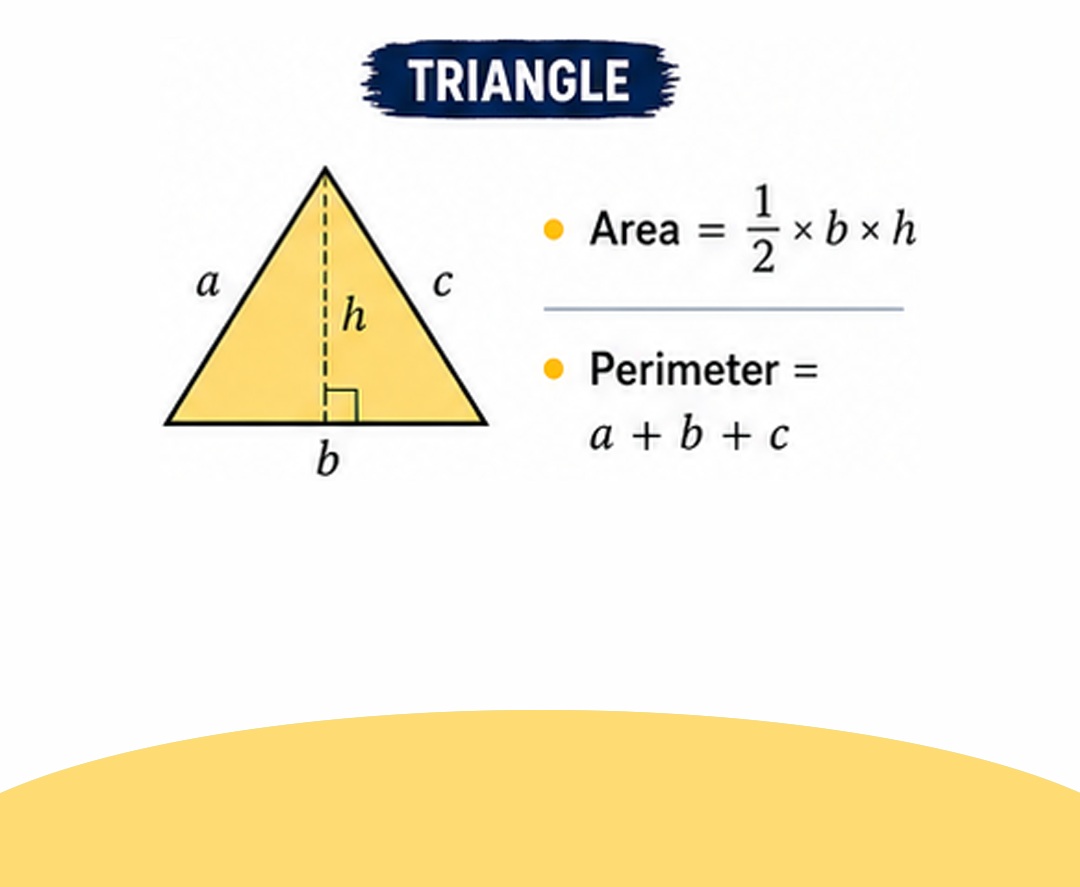
A triangle is a polygon with three sides and three angles. Triangles come in different types, but the basic area formula applies to all triangles.
Important formulas:
- Area = ½ × base × perpendicular height
- Perimeter = side 1 + side 2 + side 3
Example:
A triangle has a base of 12 inches and a perpendicular height of 5 inches.
Area = ½ × 12 × 5 = 30 square inches
If its side lengths are 5, 12, and 13 inches:
Perimeter = 5 + 12 + 13 = 30 inches
Real-life application: Triangle formulas are useful when calculating the area of triangular signs, garden sections, or other triangular surfaces.
Circle Formulas
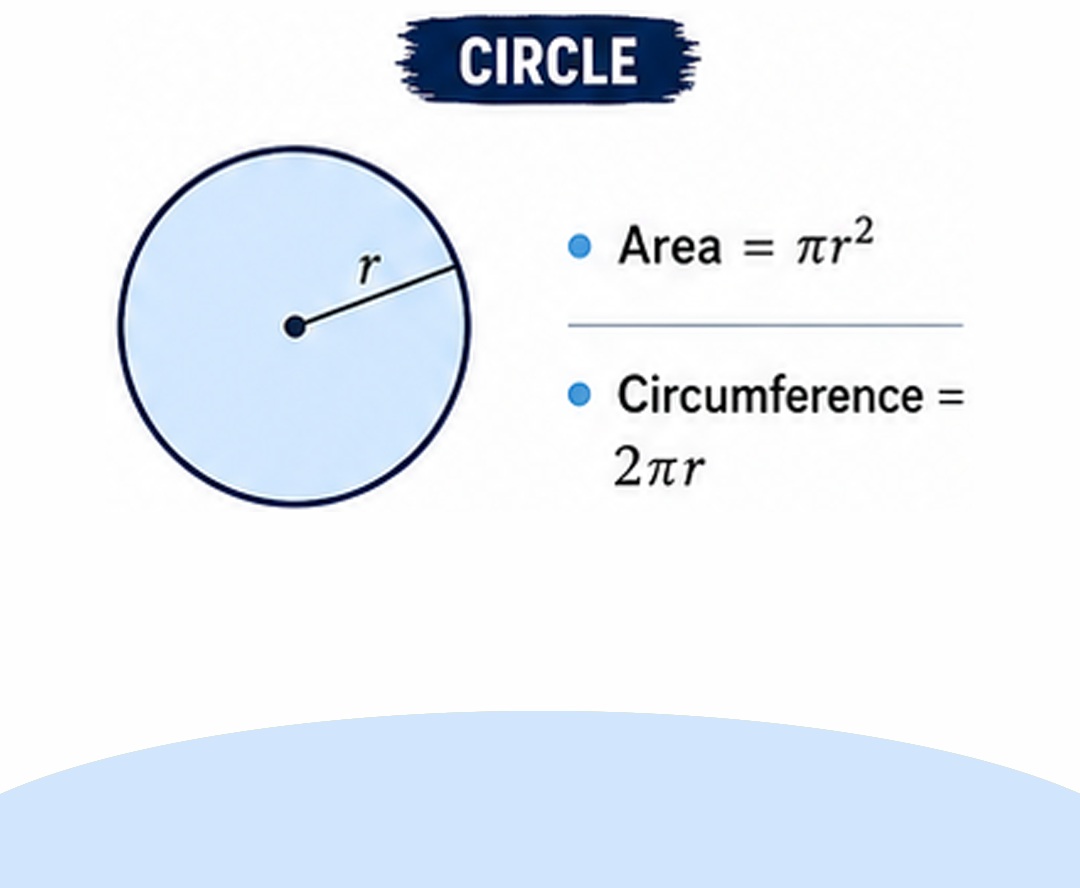
A circle is a round shape in which every point on its boundary is the same distance from its center.
The radius (r) is the distance from the center to the boundary, while the diameter (d) is the distance across the circle through its center.
Important formulas:
- Area = π × r²
- Circumference = 2 × π × r
- Diameter = 2 × r
Here, π (pi) is approximately 3.14.
Example:
A circle has a radius of 5 centimeters.
Area = π × 5² = 25π ≈ 78.5 square centimeters
Circumference = 2 × π × 5 = 10π ≈ 31.4 centimeters
Real-life application: Circle formulas help calculate the surface area of a circular table or the distance around a circular track.
Parallelogram Formulas
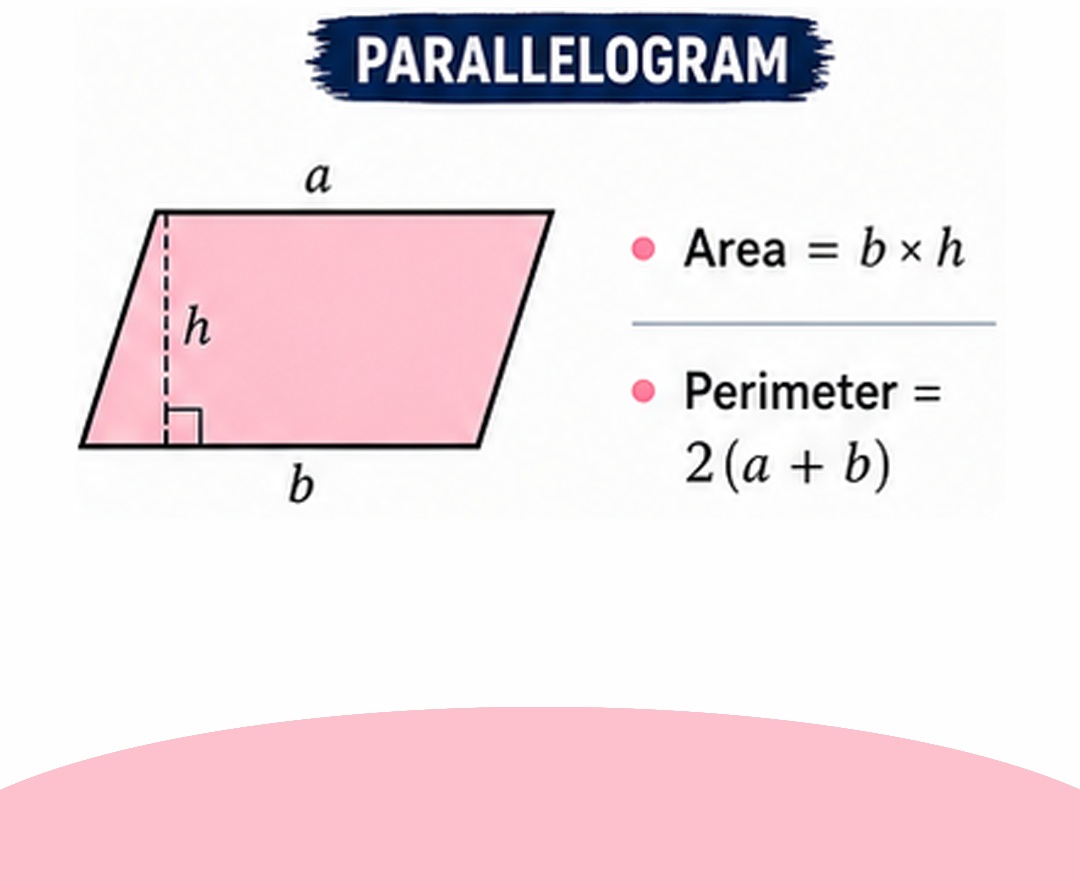
A parallelogram is a four-sided shape with opposite sides parallel and equal in length.
Important formulas:
- Area = base × perpendicular height
- Perimeter = 2 × (side a + side b)
Example:
A parallelogram has a base of 8 centimeters, a perpendicular height of 5 centimeters, and another side measuring 6 centimeters.
Area = 8 × 5 = 40 square centimeters
Perimeter = 2 × (8 + 6) = 28 centimeters
Remember: Use the perpendicular height to calculate the area, not the length of the slanted side.
Trapezoid Formulas
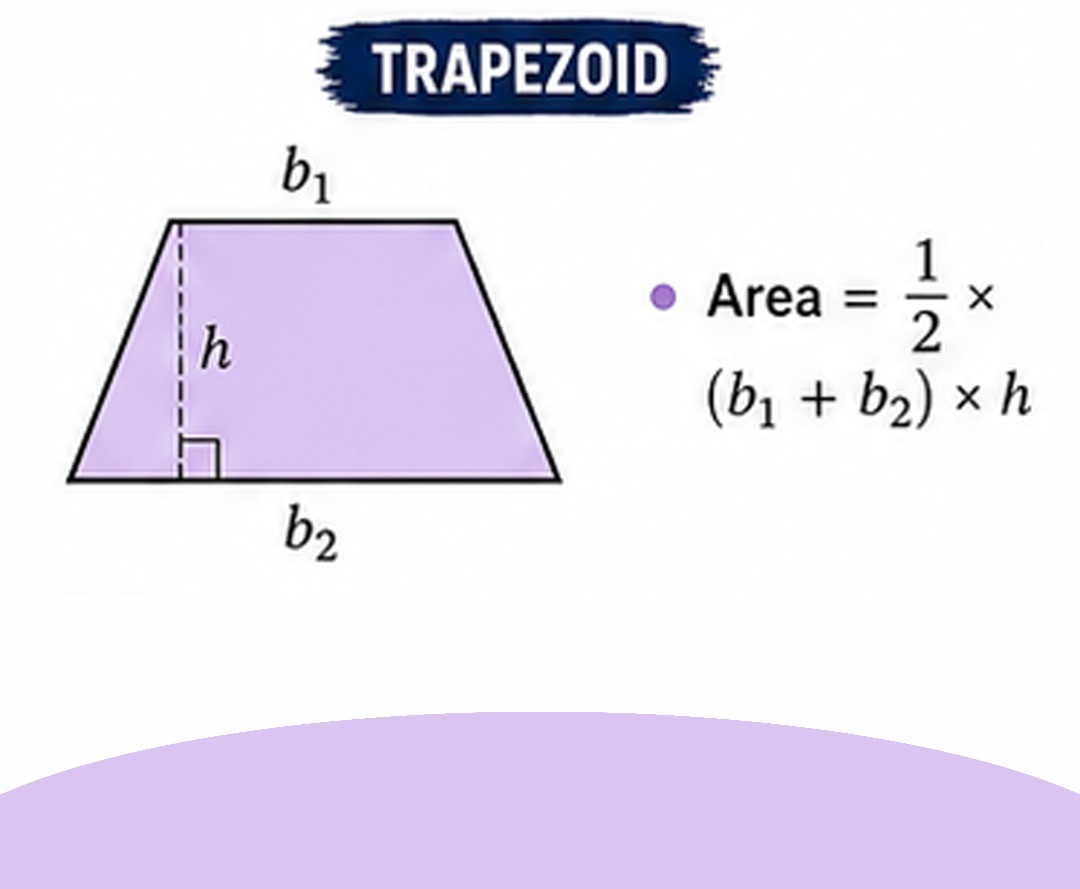
A trapezoid is a quadrilateral with one pair of parallel sides. The parallel sides are called the bases.
Important formulas:
- Area = ½ × (base 1 + base 2) × height
- Perimeter = sum of all four side lengths
Example:
A trapezoid has parallel bases of 10 inches and 6 inches and a perpendicular height of 4 inches.
Area = ½ × (10 + 6) × 4
Area = ½ × 16 × 4 = 32 square inches
Remember: Add the lengths of the two parallel bases before multiplying by the height and dividing by two.
Volume Formulas for 3D Shapes
Three-dimensional shapes have length, width, and height. Volume measures the space occupied by these objects.
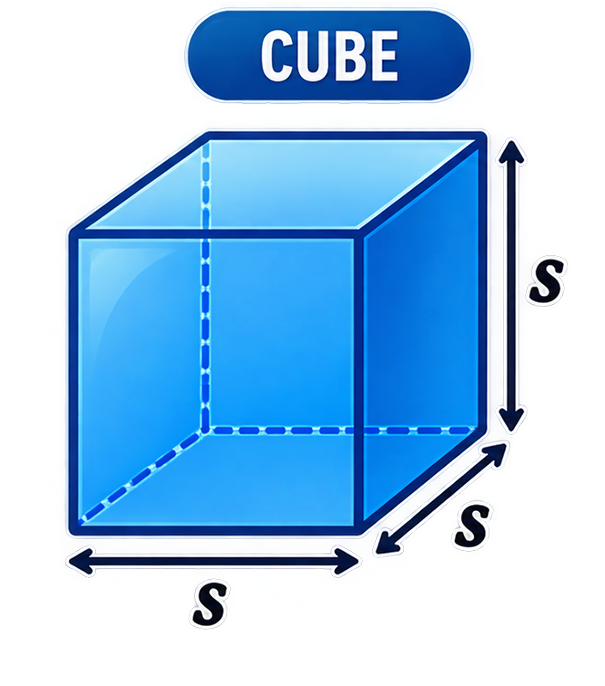
Cube
A cube has six equal square faces. Formula: Volume = side³ Example: If each side measures 4 inches: Volume = 4 × 4 × 4 = 64 cubic inches
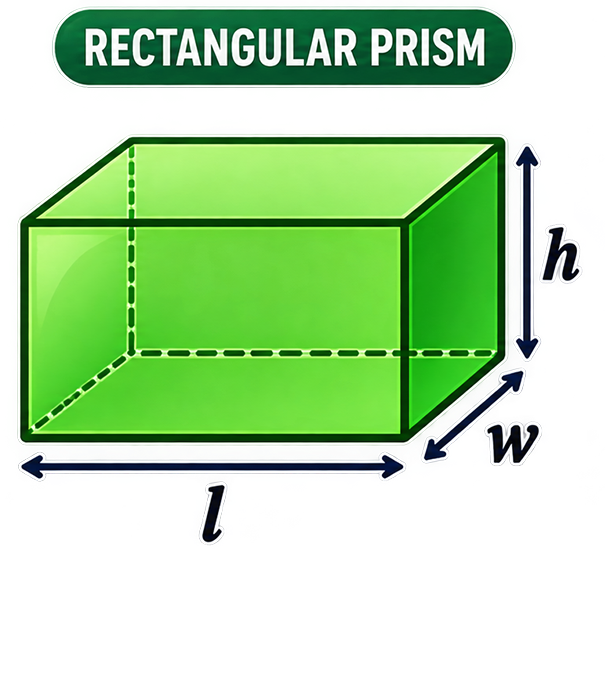
Rectangular Prism
A rectangular prism has six rectangular faces. Formula: Volume = length × width × height Example: A box is 6 feet long, 3 feet wide, and 2 feet high. Volume = 6 × 3 × 2 = 36 cubic feet
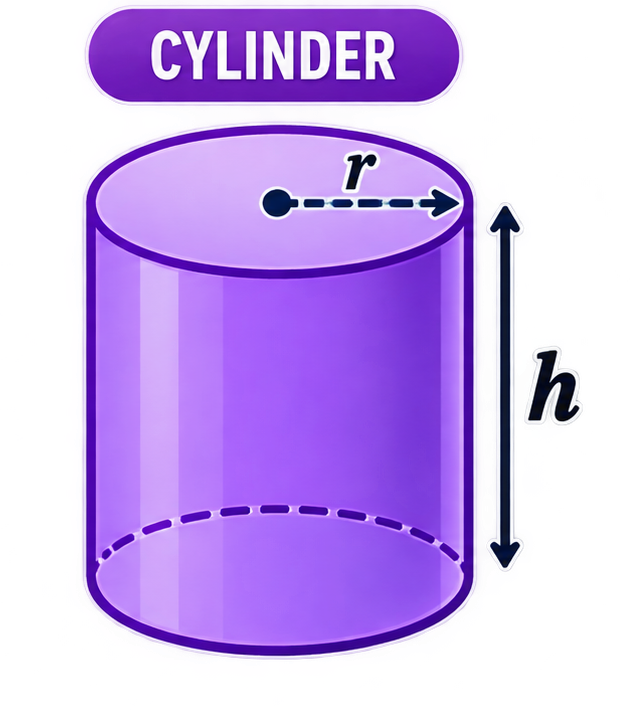
Cylinder
A cylinder has two circular bases connected by a curved surface. Formula: Volume = π × r² × h Example: A cylinder has a radius of 3 centimeters and a height of 4 centimeters. Volume = π × 3² × 4 = 36π ≈ 113.04 cubic centimeters
How to Remember Geometry Formulas Easily
Memorizing formulas is useful, but understanding them makes it easier to apply them correctly.
Here are six practical ways students can improve their geometry skills:
- Draw and label shapes. Sketch each shape and mark its sides, base, radius, and height. Visual learning helps connect formulas with their meanings.
- Group similar formulas together. Learn perimeter formulas first, then area formulas, and finally volume formulas.
- Practice with real-life objects. Measure a notebook, calculate the area of a tabletop, or estimate the volume of a storage box.
- Create formula flashcards. Write the shape on one side and its formula on the other. Review them regularly.
- Pay attention to units. Perimeter uses linear units, area uses square units, and volume uses cubic units.
- Solve a few problems daily. Regular practice helps students improve accuracy, remember formulas, and build confidence.
- Common Geometry Mistakes to Avoid
Even when students know the formulas, small errors can lead to incorrect answers.
Watch out for these common mistakes:
- Confusing area with perimeter.
- Forgetting to square the radius when calculating the area of a circle.
- Using a slanted side instead of the perpendicular height for a triangle or parallelogram.
- Using the diameter instead of the radius in a circle formula without adjusting the calculation.
- Forgetting to include all sides when calculating perimeter.
- Writing square units instead of cubic units for volume.
A useful strategy is to write the formula first, substitute the values, solve step by step, and check that the final answer includes the correct units.
Practice Questions: Test Your Geometry Knowledge
Ready to put these formulas into practice? Try solving these five questions before checking the answers.
Question 1: A square has a side length of 9 inches. What is its area?
Question 2: A rectangle is 12 feet long and 5 feet wide. What is its perimeter?
Question 3: A triangle has a base of 14 centimeters and a perpendicular height of 8 centimeters. What is its area?
Question 4: A circle has a radius of 4 inches. What is its area? Use π ≈ 3.14.
Question 5: A cube has a side length of 5 centimeters. What is its volume?
Answers
- Answer 1 : 81 square inches
- Answer 2 : 34 feet
- Answer 3 : 56 square centimeters
- Answer 4 : 50.24 square inches
- Answer 5 : 125 cubic centimeters
Try solving the questions independently before looking at the answers. If you make a mistake, revisit the relevant formula and try again.
Geometry formulas are essential tools that help students solve mathematical problems and understand the world around them. By learning the formulas for squares, rectangles, triangles, circles, parallelograms, trapezoids, and 3D shapes, students can build a strong foundation in geometry.
The key to success is not simply memorizing formulas. Students should understand when to use each formula, practice with different examples, and check their answers carefully.
With consistent practice and the right guidance, geometry can become easier, more enjoyable, and less intimidating.
Help Your Child Build Math Confidence with ArithmosPro
At ArithmosPro, we offer live, personalized online Math and English classes designed to help students strengthen their skills and develop confidence in learning.
Our expert teachers provide individual attention, explain challenging concepts step by step, and help students improve through guided practice.